Intelligence is getting cheaper every quarter, and most of the money aimed at that fact is pointed at the wrong half of it.
The question I hear in almost every room is some version of: how do we do what we already do, for less? It is a fair question with a short shelf life. When the cost of thinking falls for you, it falls for your competitor in the same quarter. Whatever margin you take out on Monday is matched by Friday. Everybody sprints. Nobody moves.
Ramp's AI index put the blended enterprise token price at $0.68 per million in September, down about 41% from a peak of $1.15 in March. That is Ramp's own card-spend panel rather than a representative survey, so hold the level loosely. The direction is not in doubt. Six months is a short time for an input cost to fall by two-fifths, and it is going to keep falling.
What every deflation has also done
The internet made information cheap. It also made Google, Amazon and Netflix possible, and none of those is an information business that learned to run leaner. Cloud made compute cheap and created categories that could not have been financed the year before.
Every wave that commoditises something quietly finances something that could not previously exist. The efficiency half shows up in your cost line within a quarter. The expansionary half shows up as a business that was not viable last year. Only the second one is defensible, because the first is available to everyone at the same time and on the same terms.
The test I apply before approving anything
Am I using this to do something cheaper, or to do something that was not previously possible?
Three kinds of answer count as the second.
Work that was too expensive to be worth doing. Qualifying ten thousand leads with the attention of a senior salesperson was never economically sane. Nobody was going to staff it. The unit cost of that attention has now fallen far enough that the arithmetic works.
Customers nobody could afford to serve. The first-time buyer comparing her options at eleven at night, in her own language, at her own pace, was never anyone's priority. She could not be. Serving her properly required a person who was asleep.
Experiences that could not be delivered at all. Contextual guidance held in memory across an entire purchase, from the first question to possession. Not a chatbot with a decision tree behind it. That did not exist eighteen months ago at any price.
None of those three is a saving. Each is a revenue line that did not previously have an owner.
Where the value goes once capability is free
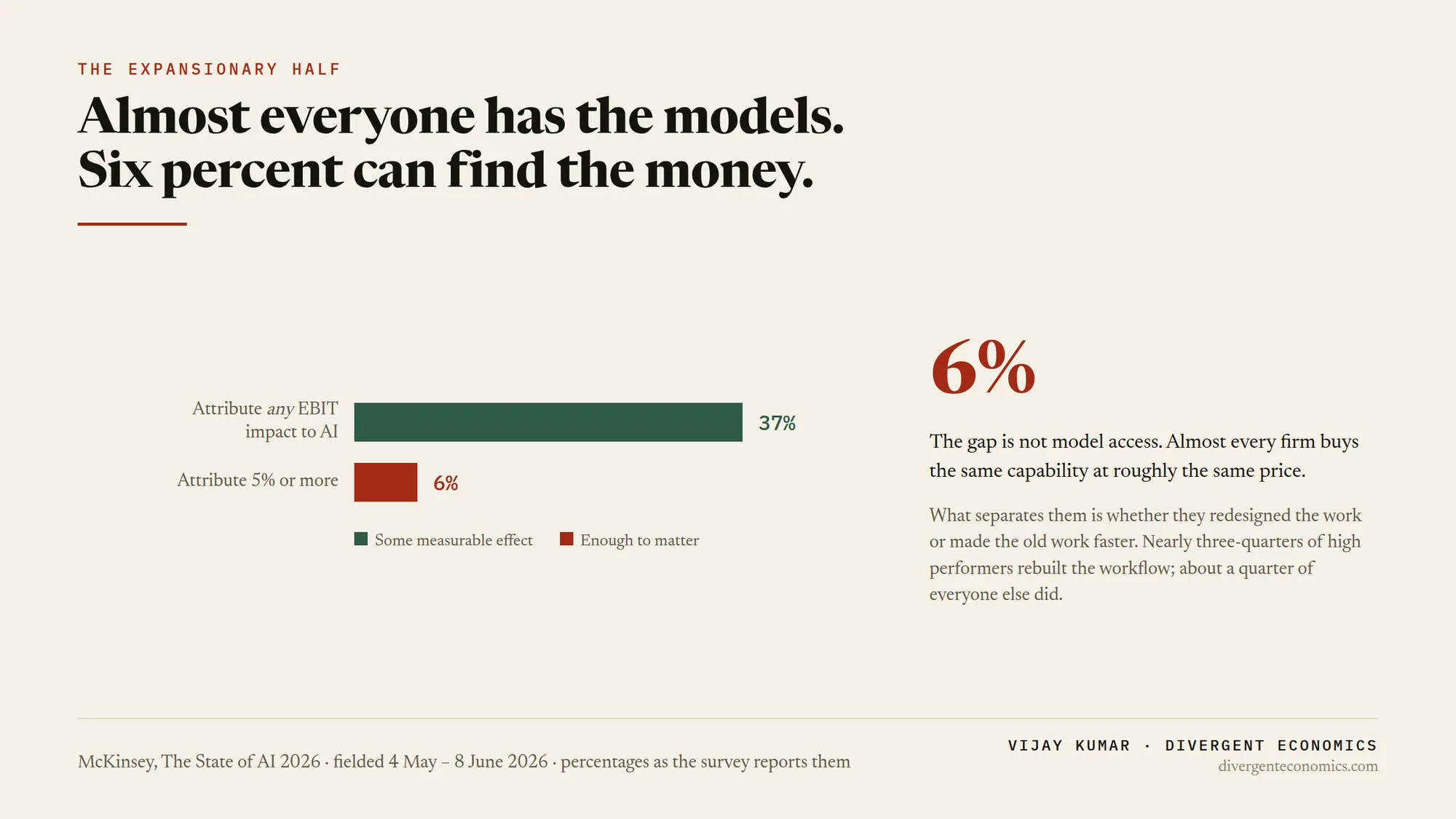
McKinsey's State of AI, fielded between 4 May and 8 June this year, found 37% of organisations able to attribute any EBIT impact at all to AI, and 6% able to attribute five percent or more.
Read that the way an operator would rather than the way a headline does. The technology is not the variable in that gap. Almost every firm in the sample can buy the same capability at roughly the same price. What separated them, on the survey's own account, was whether they had redesigned the work: nearly three-quarters of the high performers had rebuilt the workflow, against about a quarter of everyone else.
So the 6% is not a story about better models. It is a story about people who changed what the business does, sitting in the same market as people who made the existing thing faster.
When capability commoditises, value migrates to whatever the capability cannot copy cheaply. The depth of a customer relationship. A brand a stranger will hand fifty lakh to. Data nobody else has bothered to collect. An ecosystem with enough gravity to hold people inside it. And, unglamorously, the imagination of whoever decides what to build next.
Efficiency is becoming table stakes. Everyone will have it, which is precisely why it will distinguish nobody.
What I would ask in the next budget meeting
Take the AI line in your plan and split it in two. Put every item that makes an existing process cheaper on one side, and every item that makes something possible that was not possible before on the other.
For most companies I have seen, the second column is close to empty, and it is where the whole return is.
Are you using AI to protect what you have, or to build what did not exist before? One of those is a strategy. The other is a countdown.