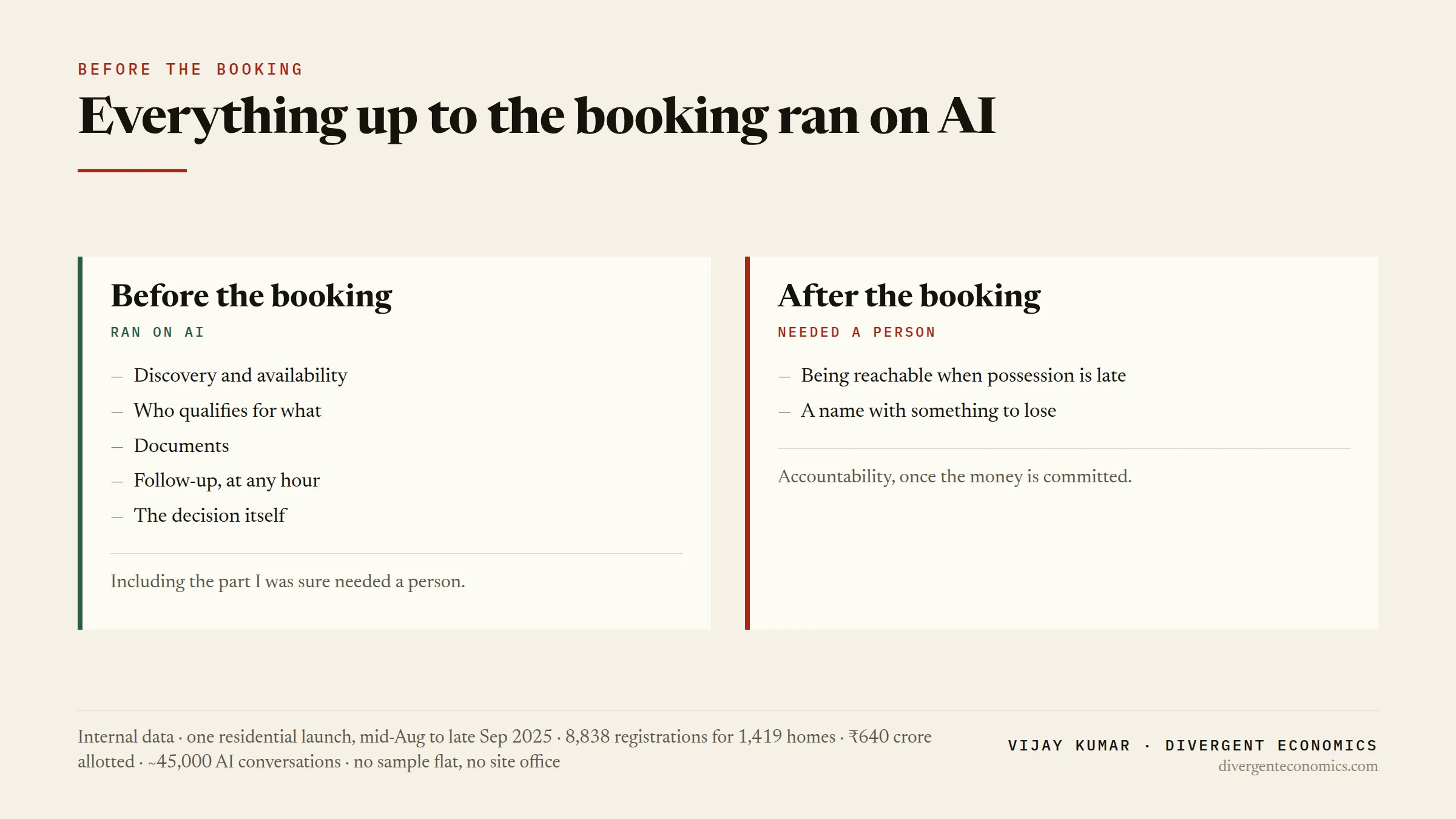
Going into last year's launch I was sure about one thing and unsure about another.
I was sure the AI could take the information work. Discovery, eligibility, availability, documentation, follow-up: all of it has a right answer, and a machine that gives the right answer at eleven at night, for the fourth time, without tiring of the question, does that work better than a person can.
What I wasn't sure about was the decision. A family committing a decade of savings to a flat they can't yet stand inside. I assumed somebody would need to be in the room for that, as a face to look at before the money moved.
I was wrong about the second part.
What we ran
A residential launch over about five weeks, from mid-August to late September 2025. No sample flat and no site office. 8,838 registrations for 1,419 homes, six times oversubscribed, ₹640 crore allotted. About three lakh unique visitors, 17,000 OTP-verified logins, and roughly 45,000 conversations handled by AI.
Most of the sales ran on AI from the first question to the booking. A person wasn't needed until after the flat was booked.
Where I'd drawn the line
Before the launch I had split the sales job into two halves in my head.
One half was the hours. Checking whether a unit is available. Explaining who qualifies for what. Chasing a document that was promised on Tuesday. Answering a question for the third time, because the person asking is about to spend fifty lakh and is frightened. Following up on a Sunday evening, because that's when the family is together and can talk about it.
The other half was the decision. Sitting with a family while they work out whether they can do this. Noticing that one of them has a concern nobody has said out loud, and knowing the deal dies if it isn't dealt with.
I expected the first half to move and the second to stay. The first moved, as I'd thought it would. So did the second, at least as far as the booking.
What I think the buyers wanted
This part is a reading, not a measurement, and the conversation logs are where I'd test it.
A frightened buyer asks the same question more than once, often late, often after a family discussion has raised it again. What they seem to have wanted was an answer that didn't change between the third asking and the fourth, there whenever the doubt arrived. A salesperson with a full pipeline can't give that every time. The AI could.
I had assumed reassurance needed a face. For this launch, it seems to have needed the same answer every time.
What was left for people
The work that needed a person came after the commitment. Once a family has booked, the question stops being whether to buy and becomes who answers when something goes wrong. Somebody has to be reachable in eighteen months when possession is late and the buyer is angry, with a name that is worth something and therefore something to lose.
That's accountability, and it is the part of the job I'd under-weighted. I had pictured the valuable human moment as the persuasion before the booking. On this evidence it sits after it.
The finding I did not want
There's a comfortable version of AI in sales: the machine takes the drudgery and people keep the judgement. Our launch doesn't support it. The pre-booking job moved whole, judgement included, and that is a much bigger change to the people who do it.
It fits a pattern in the payroll data. Stanford's Digital Economy Lab, working from ADP payroll records, finds employment for 22-to-25-year-olds in highly AI-exposed occupations about 19 percent below where it would otherwise be as of June 2026, up from 15 percent a year earlier. The declines are concentrated in occupations where AI tends to automate tasks; where it complements workers, employment is flat or rising. The authors are explicit that these are descriptive patterns, not causal estimates, and I'd hold them to that.
In their terms, what we did before the booking was automation. Which matters for one reason in particular: the way people have always entered this profession is by doing the pre-booking work for a few years until they learn the rest. If that work runs on AI, the entry route closes, and the people you'll need after the booking in five years have nowhere to learn it.
What I'd tell someone running an intermediated business
Don't assume the decision needs a person. Test it. I would have kept a human in the loop before the booking on instinct, and the instinct was wrong.
Move the work before the commitment, all of it, and put your people after it, where a buyer needs someone accountable. Then price that work properly, because in most intermediated businesses it has been paid for as though it came free with the selling.
And plan for the training problem now. The work you automated was where your next generation of experienced people used to come from.